Maze TD grows a tower tree: everything starts as a goose, and the game finally has a beginning and an end
The last post ended with a sandbox that you couldn’t actually lose. This one starts there, and then spends most of its time on a question I kept circling: how do you get from a wall to a tower?
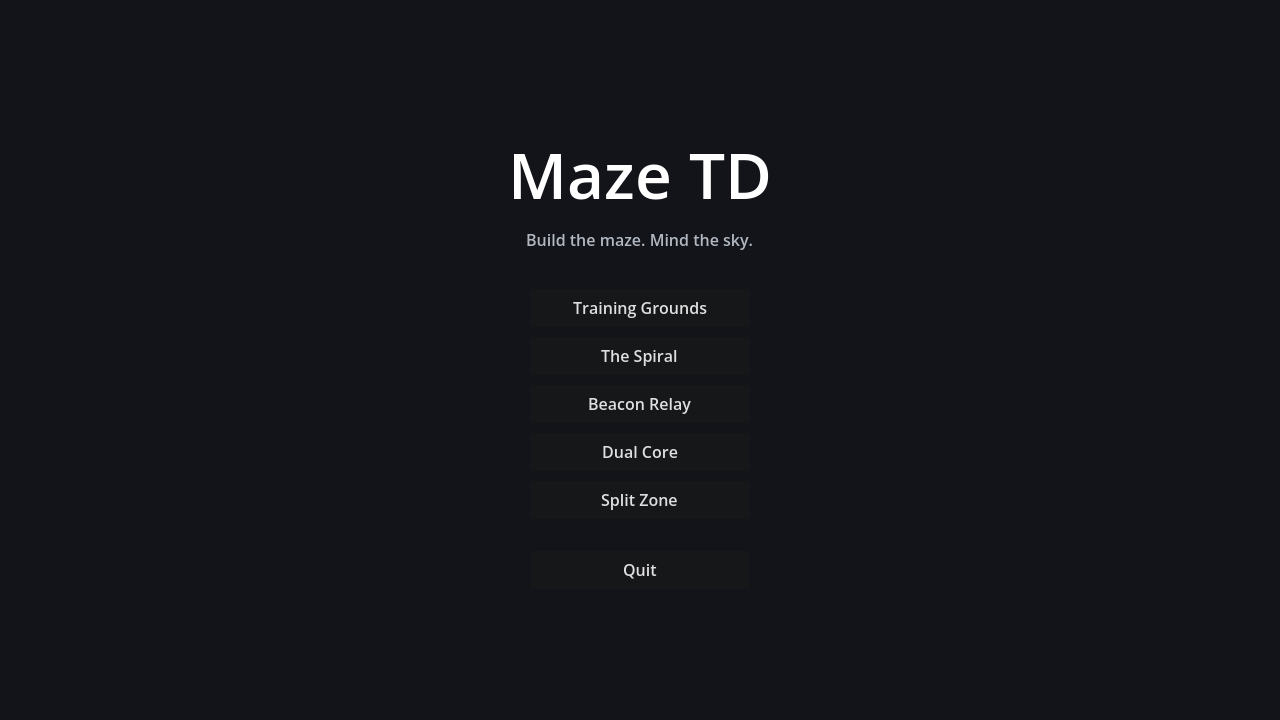
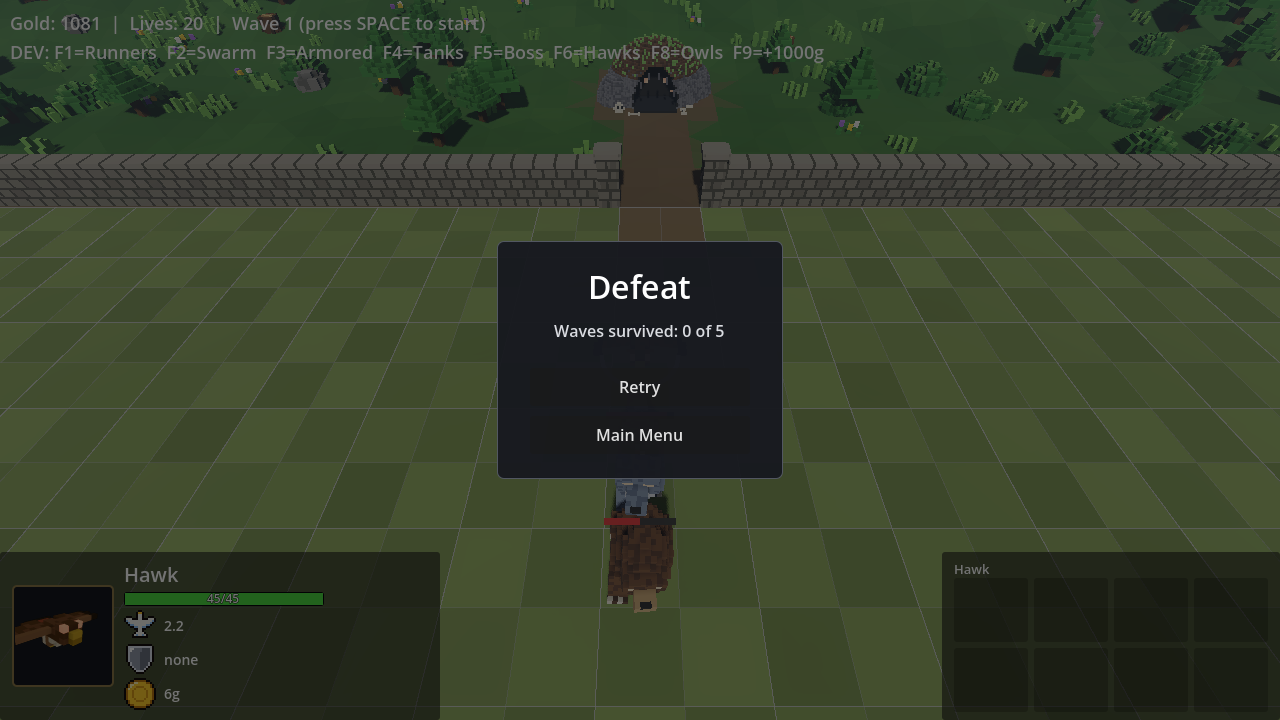
The game has edges now. There’s a main menu with the five maps on it, a pause menu on Escape, a defeat screen when the last life is gone and a victory screen when the last wave is cleared. Retry reloads the map. None of this is interesting to describe, and all of it changes how the thing feels: a run now starts somewhere and ends somewhere. The one design decision worth mentioning is that Escape is a ladder. In build mode it cancels the build, with something selected it deselects, and only with nothing going on does it open the pause menu. One key, three meanings, never the wrong one.
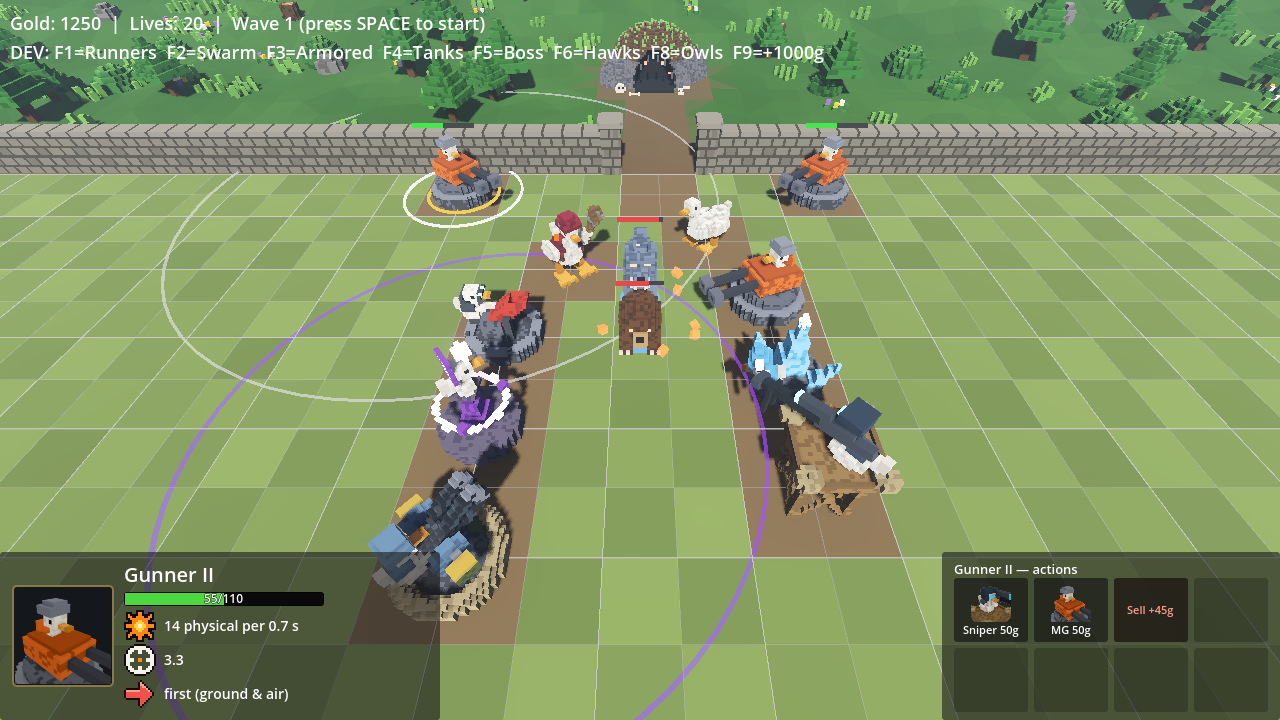
The tower tree. The air-layer post ended with the goose’s command card exactly full: seven upgrades and Sell. That was the problem. There was no room for another tower, and the late game had nothing to spend gold on that didn’t change the route. The Warcraft III tower defense maps solved this with a tree: a short generic trunk, a branch near the top, then tiers of the leaf. So that’s what this is now. The trunk is the damage type and the branch is the play style.
A goose upgrades into a Gunner (physical), a Mortar (explosive), a Mage (magic) or a Bruiser. Each trunk has a second tier, and then it forks: Gunner II becomes a Sniper or a Machine Gun, Mortar II becomes a Howitzer or a Flak, Mage II becomes Frost or Aura. Every leaf has a second tier too. Twenty towers in all, and the card never shows more than four choices. Tier-two towers wear a gold band on the ground for now, because several of the new ones are still borrowing a neighbor’s model. Selling refunds 70% of everything you spent down the chain, not just the last step, so committing early isn’t a trap.
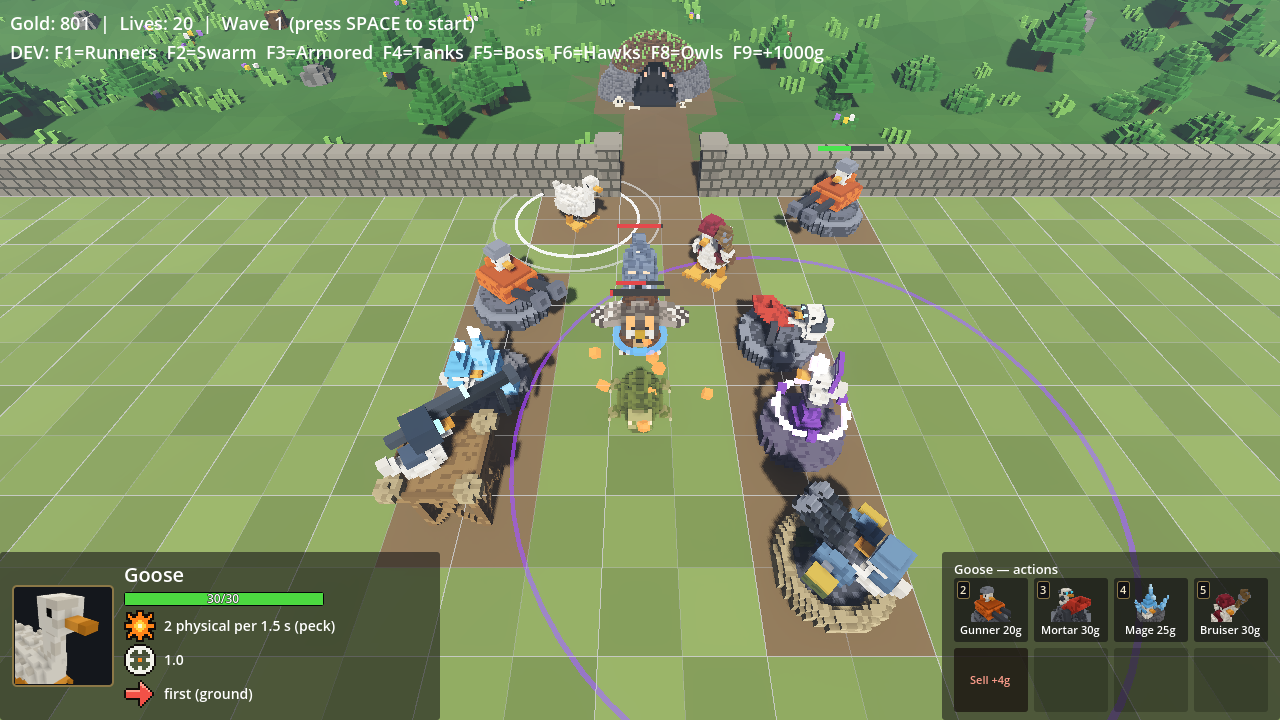
Then I took the build bar away. The first version of the tree kept five build buttons: the goose and its four children. That lasted six days. A Gunner built directly cost 20 gold, and a goose upgraded into a Gunner cost 5 plus 20, so the “skip the wall” route was simply cheaper, and the one-root idea had an exception sitting right on the hotkeys. Now the goose is the only thing you can build. Everything else is a wall that got promoted.
That costs speed, so upgrades got hotkeys. Key 1 is always a goose. Keys 2 to 5 are the upgrade slots of whatever is selected, and on a goose they’re the same towers those keys used to build, so my hands didn’t have to relearn anything.
Three tries at one click. Here’s the small dead end. Originally, placing a tower selected it, which hid the build buttons and pulled me off what I was doing. So I changed it: every click kept placing until you cancelled. That felt like a stuck Shift key, and it lasted a week. The third version is the boring correct one: a click places one tower and selects nothing, and Shift plus click keeps placing. It’s what every RTS does. I got there by trying both wrong answers first.
Predators were walking through closed corners. This is the one that stings. Enemies can step diagonally only when both squares beside the step are free, which is what makes two towers touching at a corner a sealed wall. The check that decides whether a newly placed tower forces an enemy to re-plan only looked at the squares on its path, not the squares beside a diagonal step. So if you closed a corner right as something was about to cut it, it kept its old plan and walked through. In the test that caught it, a runner passed seven millimeters from the corner of two geese. In a game about mazes, the maze had a leak.
The fix is a few lines. The same pass found that an enemy rerouted mid-step snapped back to the center of its square, up to half a meter in one frame, which read as a stutter every time you built in front of something. Now it carries on from where it stands. Both have regression tests that fail on the old code.
One health bar instead of two. The bars were built from two pieces, a dark background and a red fill that slid left as it shrank. The slide followed the direction the animal was facing rather than the screen, so anything walking sideways had a red bar floating above a full-width black one. It’s one strip now: red on the left, the missing part dark on the right, same for the towers in green.
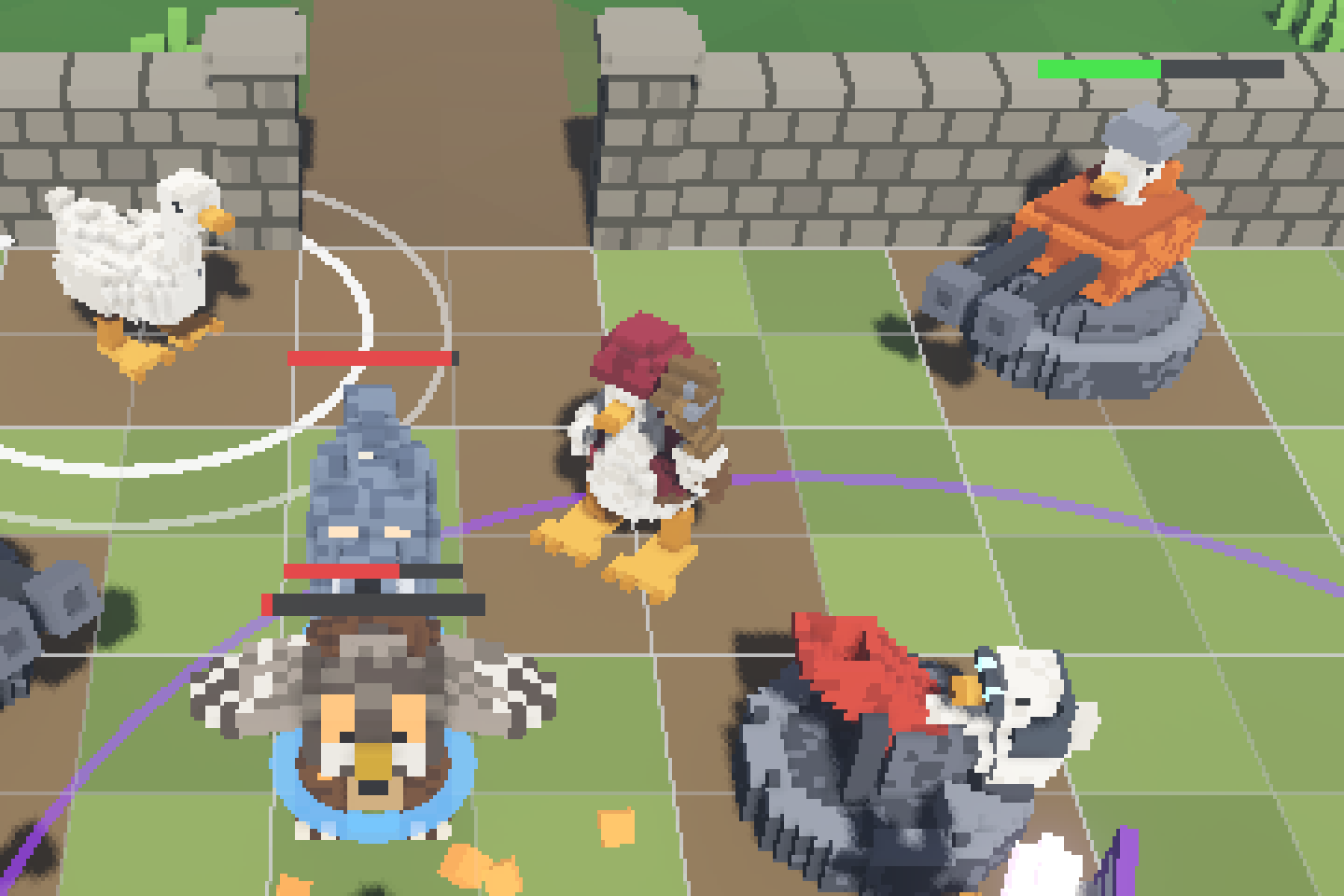
Juice. The voxel models are rigid, and it showed. So: predators pop in when they spawn, squash and flash white when hit, and stretch and puff when they die. Towers pop when placed or upgraded, kick on every shot, and breathe a little at idle. Kills float a gold number. The camera shakes when a life is lost or a boss goes down. None of it touches the rules. I’m not sure about the flash yet, since solid white under a Machine Gun might be a strobe, and a long wall of geese all breathing may be too much. That needs playing, not thinking.
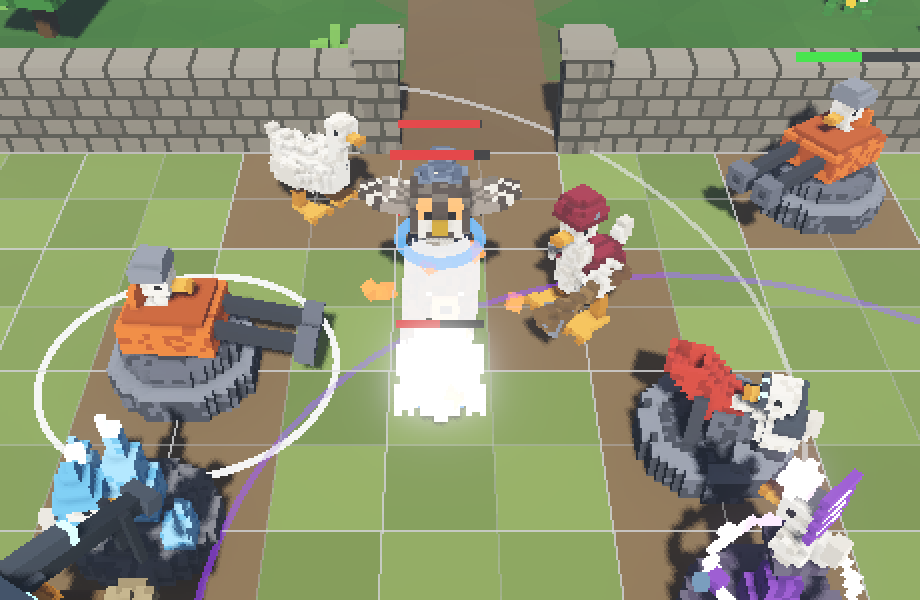
The camera learned manners. Edge panning used to be a 20-pixel band that did nothing and then moved at full speed. Now the zone is a sixth of the screen deep and the speed grows as the cursor goes in, with a quarter-second ease at the start. I tuned it three times in a row: a wider zone, then wider again, then a flatter curve so resting the cursor near the board’s edge barely drifts.
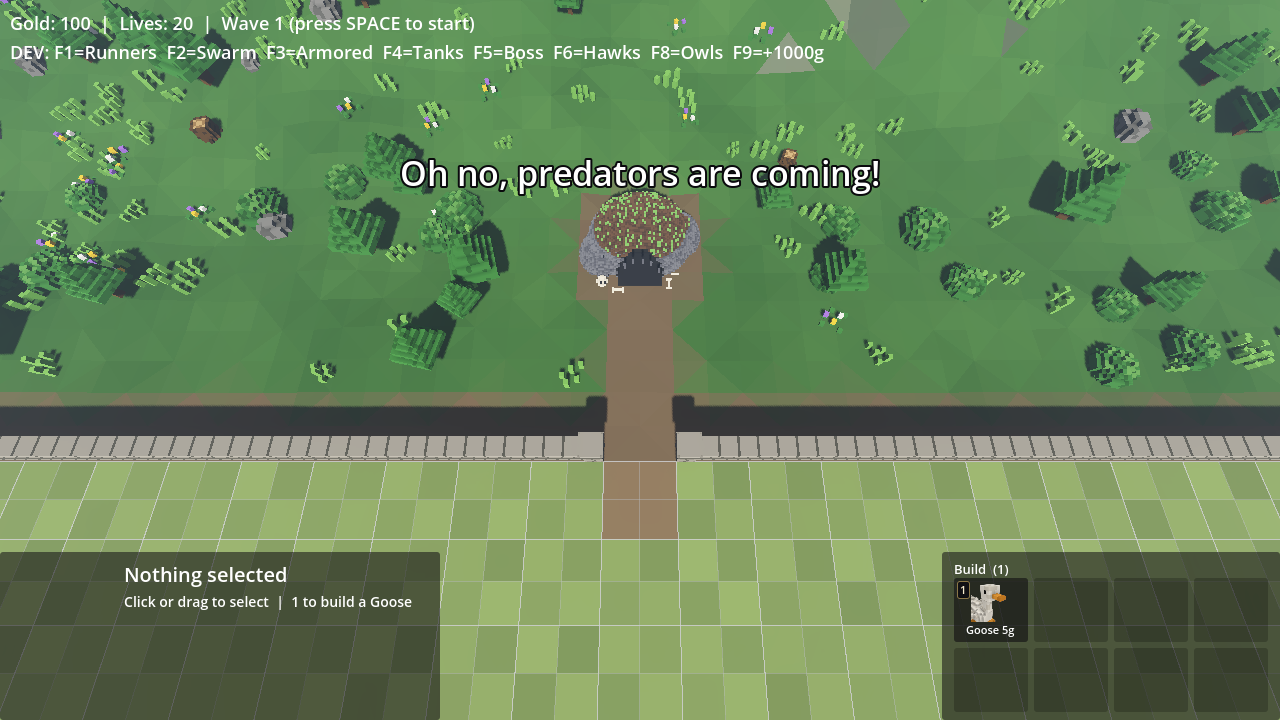
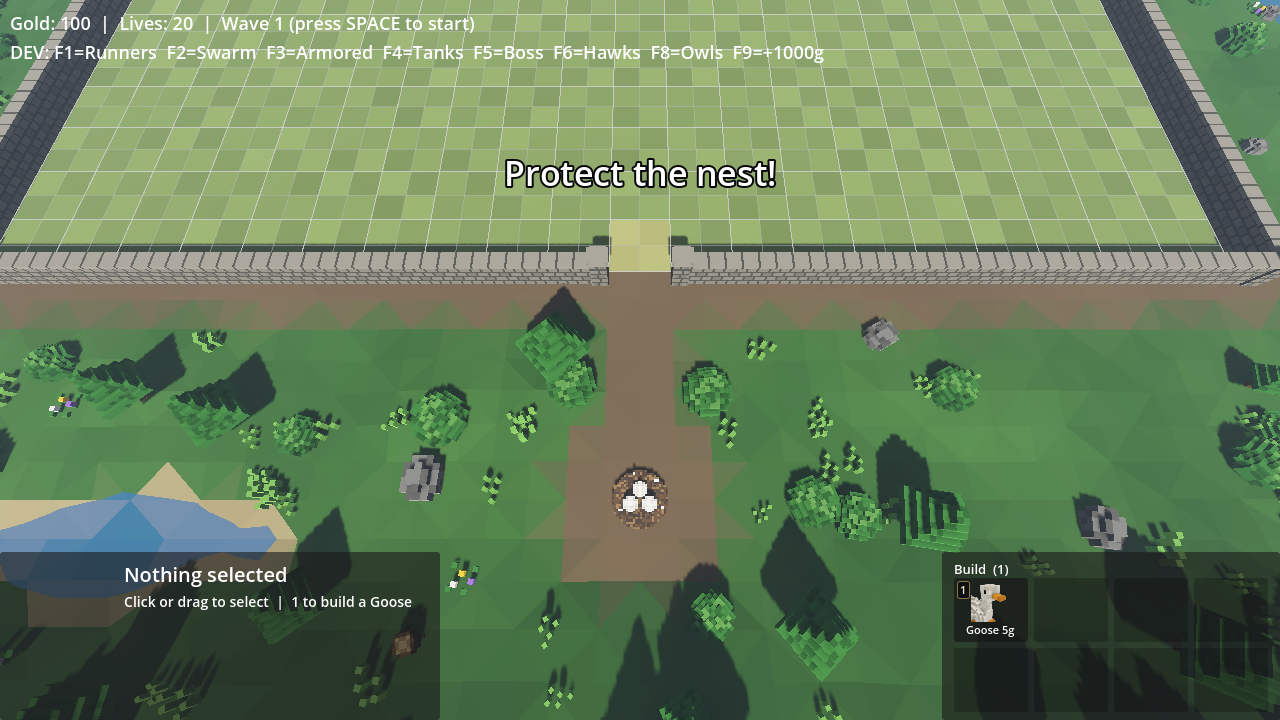
And a game now opens with eight seconds of camera. It starts wide, pushes in on the cave, pulls back, pushes in on the nest, and settles on a closer view that’s now the default zoom. Any key skips it, and Retry doesn’t replay it.
What’s still wrong. The tree’s numbers. A plain Gunner gives about 40 damage per second for every 100 gold. Nothing above it in the tree comes close: a Machine Gun is around 24 and a Sniper is around 9. Because every wall square can become a tower, squares aren’t scarce, so there’s no reason to pay more for a denser tower. A field of plain Gunners still beats every map, same as last post, and the tree doesn’t change that yet. The fix is in the tuning pass, and it probably isn’t just bigger numbers. The upper tiers need to do something a Gunner can’t.
Next: real models for the Machine Gun, Mage and Howitzer, the tuning pass that makes the tree worth climbing, and deciding whether a boss that reaches the nest should cost more than one life.