Maze TD gets an air layer: hawks over the maze, a goose with a club, and the gunner argument
The last post ended with a promise: make armor types and tower tags mean something. That happened, and it dragged a whole second dimension in with it. Before any of that, though, the HUD got taken apart, because it was in the way.
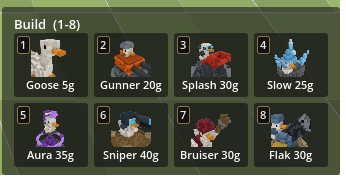
The bar split in two. The bottom of the screen used to be one full-width strip, and it hid a row and a half of board behind it. It’s now two corner panels with the board showing between them. On the left: the selected unit’s portrait, a proper HP bar, and stat rows with little hand-built 16×16 pixel icons for damage, range, targeting, speed, armor and bounty. On the right: a Warcraft III-style command card. Select a goose and the card shows its upgrades as portrait icons with their prices, then a Sell slot; select nothing and the same card holds the build buttons with their hotkeys. The card started as a 3×3 grid, which made the right panel taller than the left one and looked lopsided, so it became 4×2 and now the two corners match. Small thing. I stared at the lopsided version for a day before admitting it bothered me.
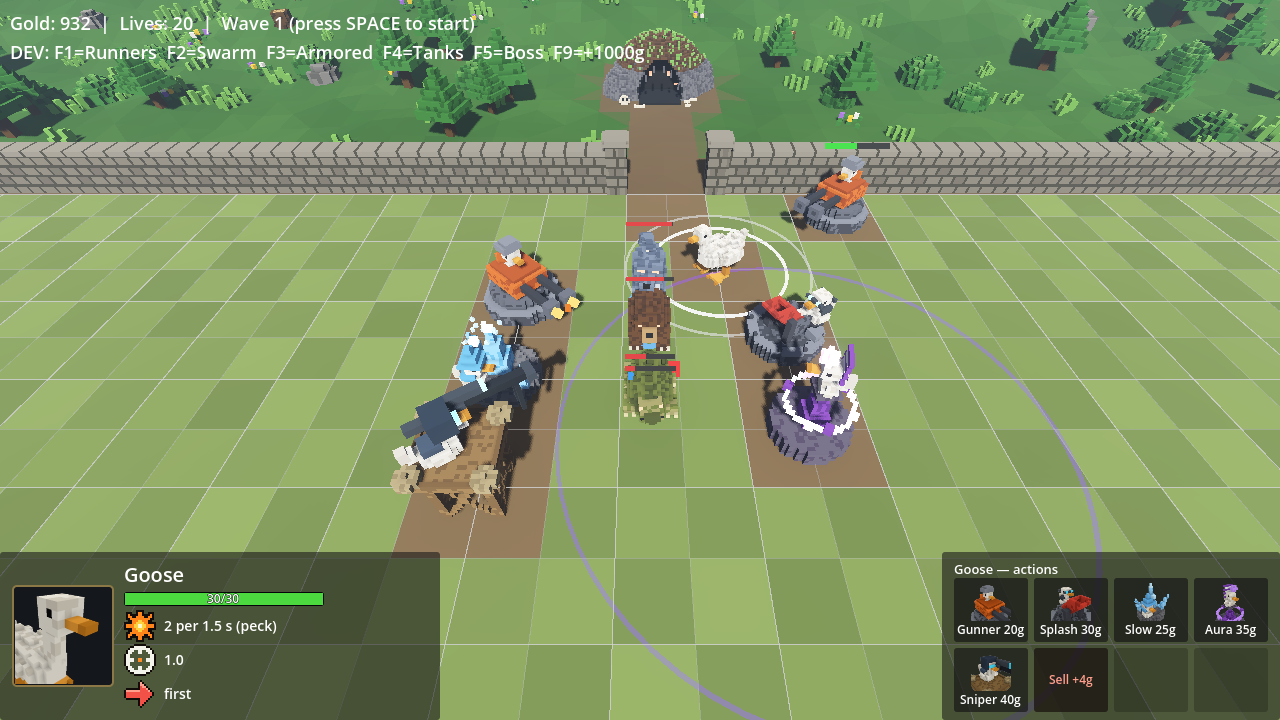
Armor means something now. Every enemy had an armor type and every tower had tags, and both were decorative. There’s a real table now: three damage types against three armor classes. Physical does 70% to armored and 85% to heavy. Explosive does 120% to armored but only 70% to heavy. Magic is neutral except that it does 120% to heavy. Goose, gunner, sniper and the new bruiser are physical; the mortar and the new flak are explosive; the frost and aura towers are magic. The armor row in the unit panel tells you the multipliers when you hover it, so the information is there without a wiki.
Then the sky. The thing I actually wanted was a predator the maze can’t stop. Two of them, in the end: the hawk, fast and fragile, and the owl, slow and armored. They fly straight lines from the cave through each checkpoint to the exit, a meter and a half over everything, and they never reroute, never attack a tower, and don’t block you from building under them. Their shadows cross the maze the geese spent ten waves building, and the geese can’t do anything about it. The first time I walled the spawn off completely and watched a hawk sail over three geese that were very ready for a fight, I knew the layer was worth it.
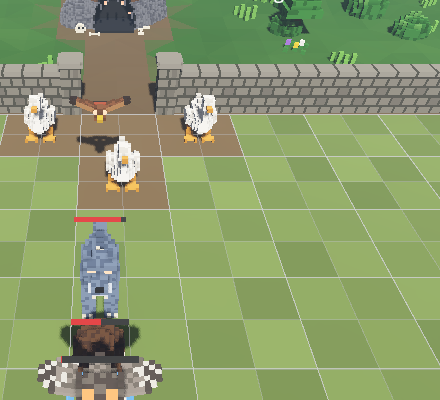
What makes it a puzzle rather than a nuisance is that the flight line is predictable. You know exactly where the birds will fly, because it’s the straight line between flags, so anti-air placement is its own little routing problem laid over the maze. Your maze bends the ground route into a spiral; the air route ignores the spiral and cuts straight across it, and you have to decide which towers sit where both routes pass.
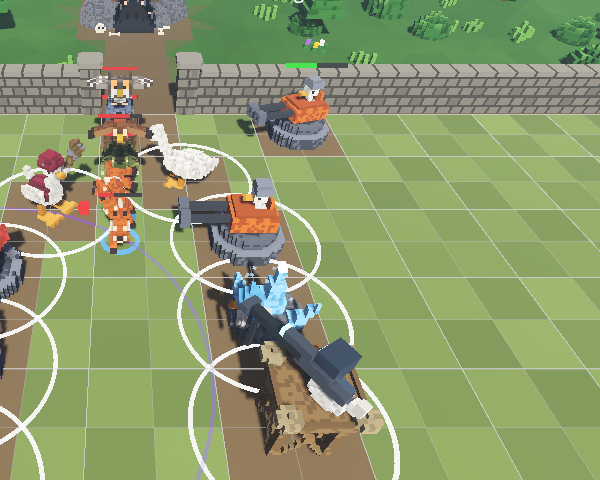
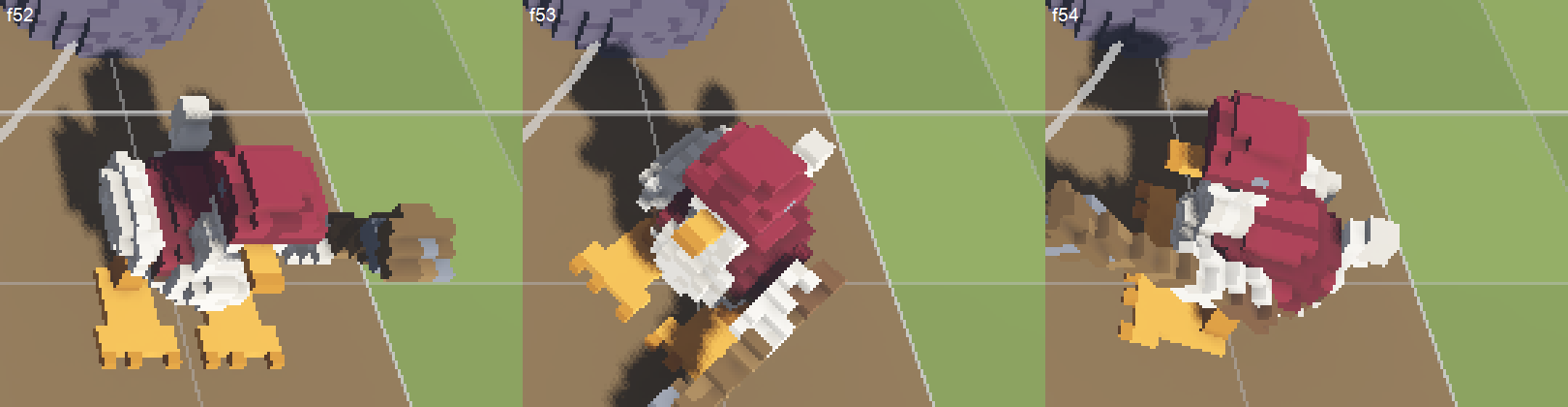
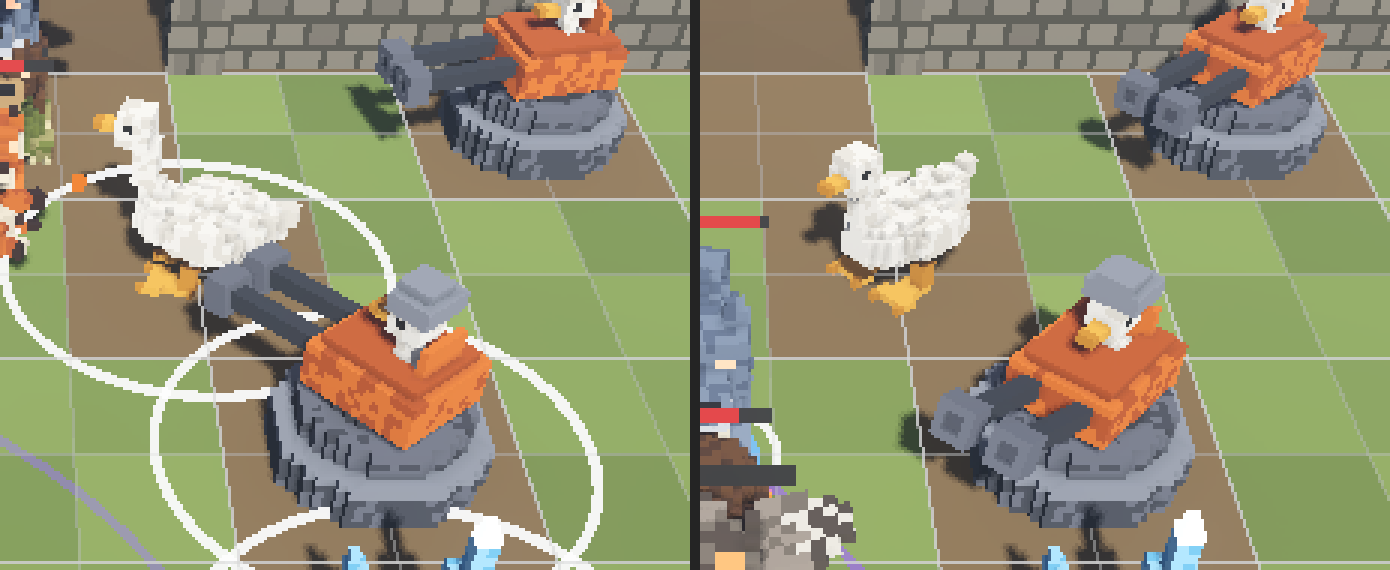
Two new geese. Flying predators need towers that care about them, and the opposite too. The bruiser is a goose in a helmet and a vest carrying a club: a 30-gold melee tower that hits for 14 and cleaves everything within a meter of whatever it hits, and can’t reach a bird at all. The flak is a crew goose behind a quad anti-air mount with the barrels raised at 45°: 12 explosive damage every 0.6 seconds at four cells, and it can’t shoot the ground at all. The old towers sorted themselves out: the mortar and the wall goose are ground-only (a mortar shell doesn’t go up), and the frost shaman, the aura spire and the sniper hit both. With seven upgrades plus Sell, the goose’s command card is now exactly full. I didn’t plan that; the 4×2 decision just turned out to have the right number of slots.

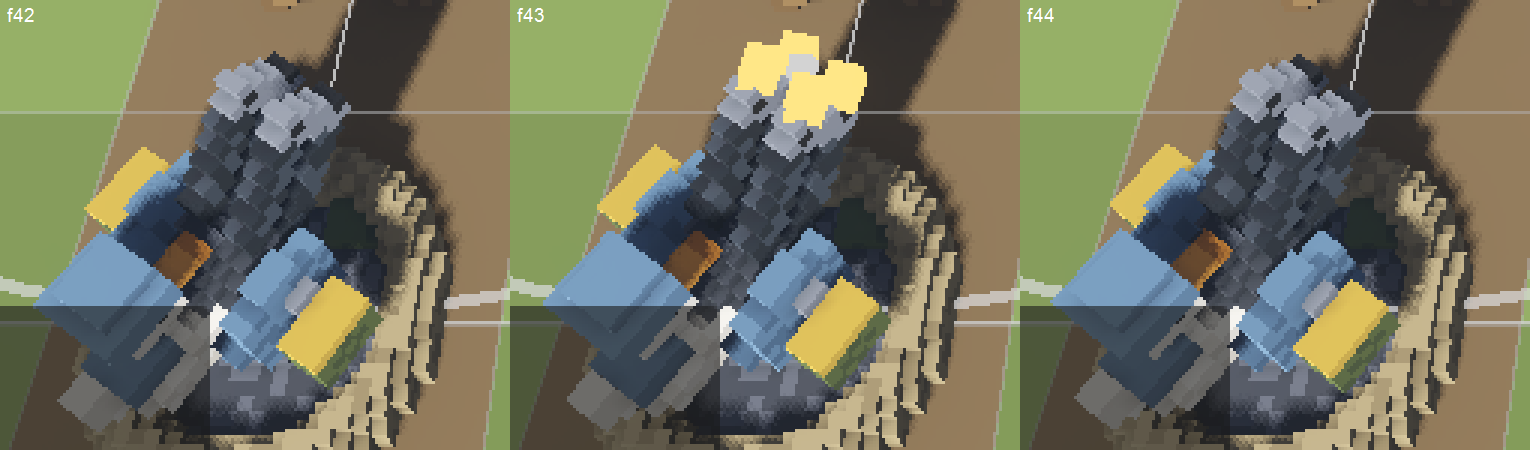
The gunner argument. Here’s the dead end for this post. I run the balance simulator across every map with three canned strategies, and the first run with air in it had a problem: nothing leaked. Not one bird on any map. The gunner-only strategy, which is supposed to be the cheese the game punishes, still won everywhere, and the flak was redundant because gunners were already shooting everything out of the sky. So I made the gunner ground-only. The table immediately looked right: gunner-rush now died to the first big air wave on every campaign map, around wave 11 to 15, while the mixed strategy still won.
It read right in the table and wrong in the hand. A basic ranged tower that can’t shoot a bird flying over it is just weird. The arrow tower in Warcraft III hits air; the cannon doesn’t; that’s the convention players carry in, and I’d broken it to make a spreadsheet behave. Reverted. Then I tried the honest version of the same fix, doubling the armored owls on the late waves, and that matrix came back identical to the one before it in every cell except gold. The flight line is long enough and a wall of gunners has enough damage that eight owls simply die in the air. So gunner-rush wins the campaign maps for now, and I’m fine with that. The simulator is a regression check, not the design target, and the real lever for air pressure is how far the flight line runs from where a mazer’s towers sit, which is a map-design question I’m saving for the tuning pass.
Barrels that look up. Towers aimed at their target’s feet, which nobody noticed when every target was on the ground. With birds overhead the gunner fired level while the owl went past above its muzzle. Towers aim at the body’s center now, projectiles fly to the same point, and the gunner, the sniper and the flak pitch their barrels at it, easing up and down at the same speed they turn. The flak needed a floor: a bird a few meters out is only ten or twenty degrees above the mount, so the first version dropped the cluster from its raised pose to shoot and looked less anti-air than it did at rest. It never dips below 30° now.
The camera stopped remembering. The orbit camera from last week let you rotate and tilt the view with a right-drag, and it kept whatever you did. That turned out to be a mistake in practice: every so often I’d brush the right button during a drag, the board would end up ten degrees off, and getting it exactly back meant knowing the Home key. Rotation and tilt are a peek now. A third of a second after you let go, the view eases back to the default angle over about a second. Zoom and position stay where you put them. It feels obvious in hindsight, which is the usual sign.
So the game has two layers now, a damage table that makes the armored waves feel different from the fast ones, eight towers, and a lesson about trusting a simulator over a convention. Still open from the roadmap: a ghost that phases through part of the maze, a siege unit, the wave-size tuning pass, and the menus and game flow that turn the sandbox into something you can actually lose.